
Understanding Service Fees vs. Payment-Method-Specific Surcharges
When schools accept online payments, there are often real costs associated with processing and managing those transactions. This article explains the difference between a standard service fee and a payment-method-specific surcharge.
This article is for general informational purposes only and is not legal or financial advice.
What Is a Service Fee?
A service fee is a standard fee applied consistently to online transactions to help cover the operational costs of accepting and managing payments.
These costs may include:
- Payment processing fees
- Billing and invoicing software costs
- Fraud protection and payment security
- Platform infrastructure and support
- Online payment management tools
Onespot uses Stripe for payment processing and billing infrastructure.
Stripe’s public pricing information can be viewed here.
Key Characteristics of a Service Fee
- Applied according to the school’s configured invoice fee settings
- Not presented as a fee added only because a specific card type was used
- Intended to help offset processing and platform costs
- Typically shown transparently on the invoice
Common Examples of Service Fee Models
Service fees are commonly used across many online platforms and payment systems.
Relevant examples include:
- Online tuition and billing platforms
- Brightwheel
- Instacart
- DoorDash
- Utility payment portals
- HOA payment systems

In these examples, the fee is generally tied to the convenience, infrastructure, payment processing, fraud protection, and software services being provided — not necessarily because a specific card type was used.
Onespot Service Fee Structure
Schools using Onespot may choose to configure a standard service fee to help offset broader payment-processing and billing costs.
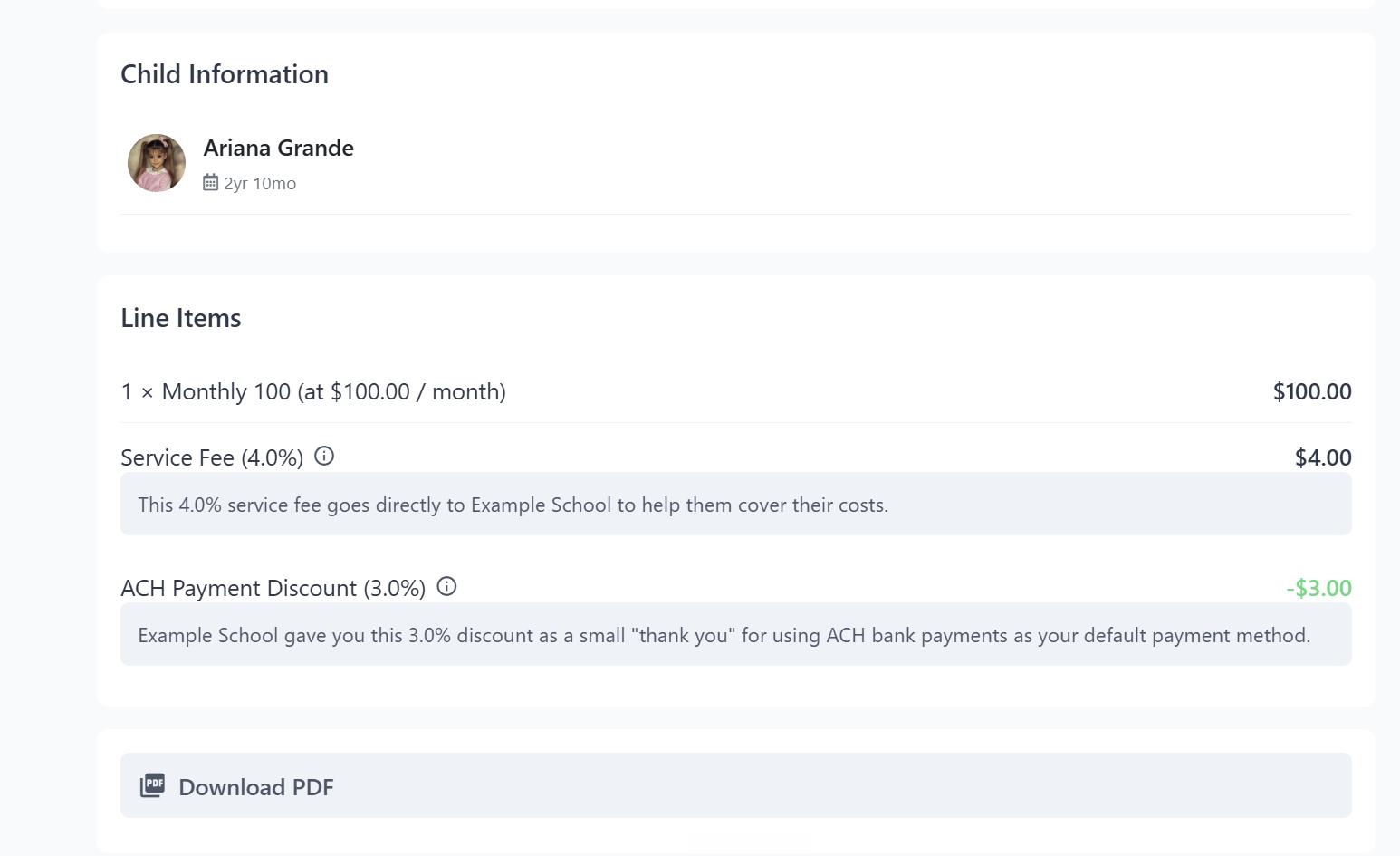
Stripe’s underlying costs can vary depending on the payment method used. For example:
- Card payments generally cost more to process
- ACH/bank payments are generally less expensive to process
- Stripe may also charge additional billing or invoicing-related fees
Even though the underlying processing costs may differ between ACH and card payments, the service fee itself is structured as part of the invoice and is not necessarily framed as an extra charge triggered only because a certain card type was used.
Some schools may also separately offer ACH discounts because ACH payments are generally less expensive to process.
What Is a Payment-Method-Specific Surcharge?
A payment-method-specific surcharge is a fee added specifically because a certain payment method was used.
Examples could include:
- Charging extra only for credit card payments
- Charging a fee only when a debit card is used
- Applying different fees depending on the card network or payment type
Key Characteristics of a Payment-Method-Specific Surcharge
- Applied only to specific payment methods
- Directly tied to the type of card or payment used
- May be subject to different rules or regulations depending on location
Important Note
Rules regarding payment fees and surcharges can vary by state, country, payment processor, and card network.
Schools should review their payment processor’s terms and consult appropriate legal or financial professionals if they have questions about compliance requirements specific to their situation.